




National Retrofit Strategy NRS
|
Contents |
[edit] Introduction
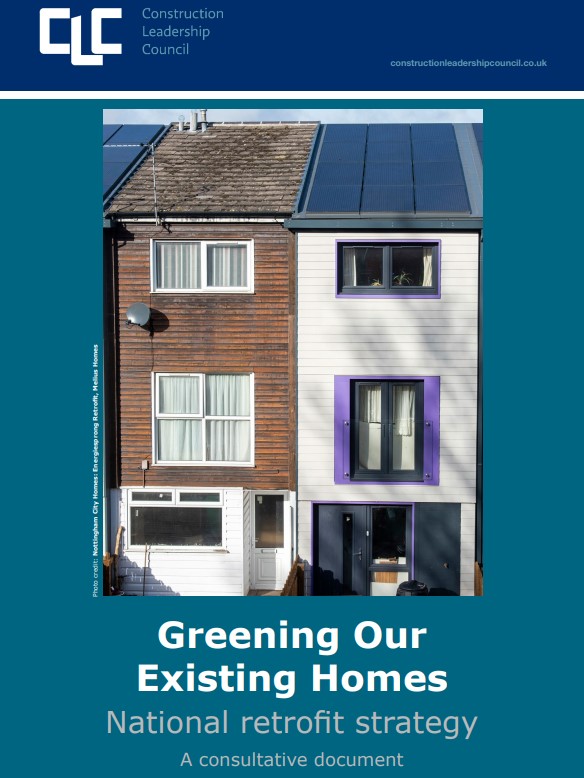
In December 2020, the Construction Leadership Council (CLC) announced its support for the creation of a National Retrofit Strategy (NRS). In conjunction with the announcement came the CLC's publication of the consultation, Greening Our Existing Homes.
Following the consultation, the second iteration of the National Retrofit Strategy was published on 28 May 2021, setting out how the construction industry can work with Government to retrofit the UK’s 28 million existing homes.
[edit] Purpose of the NRS
Existing homes use 35% of all the energy in the UK. They are also responsible for 20% of carbon dioxide emissions. The NRS puts forward a plan for upgrades that are vital if the country intends to meet its net zero targets.
The intention of the plan is to help make homes greener and more energy and water efficient, warmer and more affordable to run. This is in line with the UK Government’s target to upgrade as many homes as possible to Energy Performance Certificate (EPC) C by 2035.
[edit] Specific strategies
Ideally, the NRS will aid recovery in the repair, maintenance and improvement (RMI) sector, and provide opportunities for a cohesive approach to addressing the issue of climate change by all parts of the construction industry.
The strategy calls for partnership working between industry and Government based on three key deliverables:
- Creating a ‘building passport’ in the form of building renovation plans for every home.
- Developing skills training modules consistent with PAS 2035/2030 (Retrofit Coordinator training standards)
- Providing delivery programmes in trial areas to serve as best practice models and foster a grassroots approach.
[edit] Development of NRS
The NRS was developed by participants of the Domestic RMI Workstream. This group was formed to bring together specialists and representatives from the supply chain to address sector priorities. The group is one of the CLC’s four sector specific workstreams created to explore issues related to the COVID-19 pandemic recovery.
CLC Steering Coordination Group member Mark Reynolds said, “Retrofit promises a great deal for the sector, including a long-term pipeline of work. Not limited to this, retrofit brings opportunities for upskilling, digitisation and innovation, which are all in line with the Construction Sector Deal.”
[edit] Related articles on Designing Buildings
- CIOB holds net zero event with industry experts and UK Government.
- Construction Leadership Council CLC.
- Energy performance certificate EPC.
- Engineering services and industry recovery guide.
- Households Declare.
- IHBC COP26 podcasts.
- National Retrofit Strategy v2 launches.
- PAS 2035.
- Plan proposes to reinvent construction industry.
- Recommendations for implementation of the National Retrofit Strategy.
- Retrofit.
- Retrofit Coordinator.
- The Construction Playbook.
Featured articles
Check out some of the best features and news from Designing Buildings as well as key stories from around the web.

Government approach could undermine delivery and regeneration.
World's first mass timber data centre.

The overlooked environmental aspect of data centre development.
Introduction to radon awareness

New technical information sheet published by CIOB.

Updated supplier guide can help electrical contractors engage with NHP.

CIAT confirm the winners of the 2026 architectural technology awards.

Government launches a one stop shop for flood preparedness.

Sir Edwin Lutyens: Britain's greatest architect? Book review.

CIOB publishes free template to help assess and manage risks.
ECA's reflections on Party Conference season

Burnham wants to be confident of winning before asking for a fresh mandate.
New Chief Construction and Scientific Adviser

Sergio Cavalaro, Professor of Infrastructure Systems at Loughborough University.
Building safety levy for England

CIAT publish estimator tool for members.

Water sector faces a growing crisis that could slow the delivery of vital infrastructure.